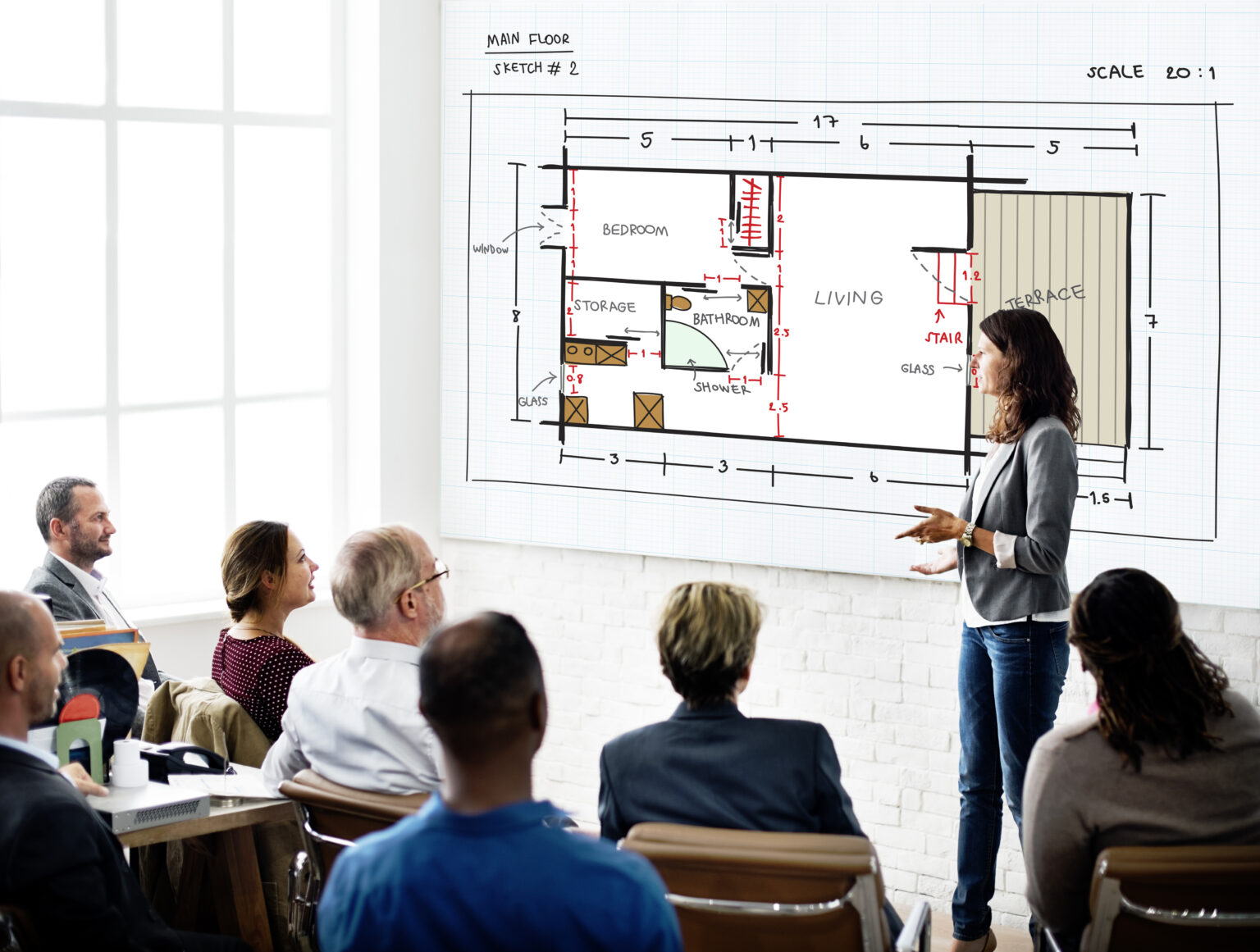

Every architect knows that exact moment when their stomach drops. It usually happens late at night when the phone rings and a frustrated general contractor is on the line. The message is always the same: “We have a problem out here; things aren’t lining up.” A massive structural steel column is fighting for the exact same physical clearance as a main HVAC duct, or a custom millwork piece blocks a required hallway access path.
Out on a real-world construction site, minor paper errors never stay small. They quickly balloon into expensive field reworks, wasted materials, and endless arguments over who is going to pay for the mistake.
Walking away from loose sketches and disorganized internal design setups is the only way to protect a project’s bottom line. Forward-thinking firms are turning to professional cad drafting services as a dependable, everyday quality control system. Let’s dig into exactly how high-precision documentation keeps a creative design concept from turning into a chaotic field headache.
The True Cost of Precision Mistakes on the Job Site
Before looking at the technical workflows, we have to look honestly at what happens when documentation slips. A gorgeous hand rendering or a conceptual mood board is perfect for getting a client excited. However, those creative assets cannot help a concrete crew layout a foundation correctly. If the underlying construction documentation contains layout mismatches, the entire project is in trouble before building even starts.
Historically, tracking down geometric conflicts across hundreds of separate blueprint sheets was a nightmare. An architect might shift an interior wall by six inches on a floor plan, but the plumbing or electrical layouts never get the update.
These small administrative oversights stay hidden deep inside the paperwork. They wait quietly until a sub-contractor tries to bolt a physical component into place on-site, forcing operations to grind to an expensive halt while everyone waits for a fix.
1. Establishing Standards Through AutoCAD Drafting Services
This structural gap is where specialized AutoCAD drafting services step in to stabilize the entire development phase. Bringing your design development sheets into a clean, unified digital environment removes the human variance that ruins manual layouts.
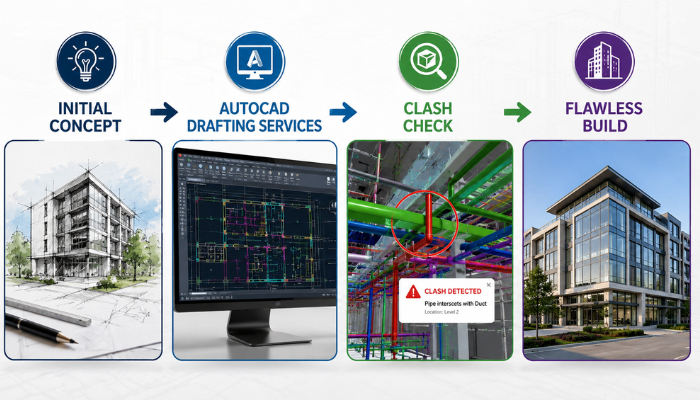
Modern digital drafting systems enforce rigid mathematical rules across your entire plan set. Professional teams build files using strict layer organizations, uniform line weights, and clear geometric dimensions.
Because of this disciplined setup, every single vector line on a blueprint represents a fixed, real-world coordinate. Whether a contractor checks the files on a tablet in the mud or an inspector reviews them at city hall, there is zero room for guesswork or interpretation.
2. Elevating Fit-Outs with Specialized Interior CAD Services
True architectural precision cannot stop once the exterior structural walls are drawn. When you are building out high-end retail locations, modern office spaces, or boutique hospitality projects, the interior installations demand incredible detail. This is exactly where dedicated interior CAD services protect your execution.
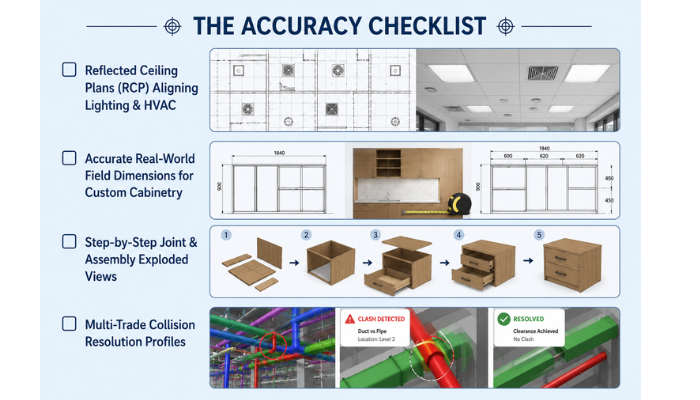
Standard schematic plans rarely provide the hyper-focused measurements required for custom interior work. Specialized interior drafting solves this by mapping out exact reflected ceiling plans (RCPs), complex finish schedules, and millwork fabrications down to a fraction of an inch. When your custom cabinetry and features arrive on-site, they fit perfectly into the physical room without requiring last-minute field cutting.
3. Visualizing Precision Through 3D CAD Rendering
Flat blueprints are great for calculation, but human brains are hardwired for dimensional depth. Sometimes, a project manager can stare at a two-dimensional section view for an hour and still miss a subtle structural conflict. Using advanced 3D CAD rendering acts as a crucial visual safety net during design reviews.
Converting flat line work into a realistic, three-dimensional digital space completely changes how teams spot layout errors. A full 3D model lets you inspect tricky construction junctions from absolutely any perspective.
You can easily see if an interior ceiling soffit runs directly into a structural support beam or blocks a critical fire sprinkler line. Spotting these spatial issues on a computer monitor costs virtually nothing to fix compared to tearing down completed drywall on a job site later.
4. Resolving Conflicts with Advanced CAD Visualization Services
High-end renderings are fantastic for pitching ideas to project investors, but professional CAD visualization services do a lot of heavy lifting behind the scenes too. Modern buildings are packed with incredibly tight networks of structural steel, framing, plumbing lines, and electrical conduits that all have to share space.
Using advanced visualization workflows lets your engineering teams run automated clash-detection passes before building begins.
- Space Coordination: Tech teams combine every subcontractor’s separate CAD files into a single master model.
- Clash Detection: Specialized software scans the model and flags every spot where two pipes or beams occupy the exact same coordinate.
- Proactive Revisions: Fixing these issues on screen means you hand your site crews a clean, coordinated set of construction drawings that actually fit together.
5. Tailoring Accuracy: Residential vs. Commercial Demands
The type of precision your project requires depends entirely on what you are building. A flexible drafting partner knows how to shift their focus to match the specific regulatory hurdles of different sectors.
Residential Architectural Drafting Services
In the custom home and multi-family housing world, accuracy is all about maximizing space and managing expensive finishes. High-quality residential architectural drafting services spend time optimizing floor space, refining kitchen cabinet layouts, and detailing intricate trim connections. Precision here keeps homeowners happy and stops teams from ruining expensive, specialized materials.
Commercial Architectural Drafting
When you step up to large-scale infrastructure, commercial architectural drafting requires intense code tracking and coordination. Drafting teams have to cross-reference massive structural frames, complex exit pathways, firewall lines, and heavy-duty utility frameworks. A single oversight on a commercial print can lead to a failed municipal inspection, delaying an opening by weeks.
Why Modern Firms Partner with CAD drafting firms
Running a large, in-house technical team is a massive financial burden for any studio. Keeping up with constant software subscription updates, hardware upgrades, and specialized training can drain an agency’s profits quickly. When project workloads spike unexpectedly, internal staff burn out fast, and oversight mistakes start slipping into the prints.
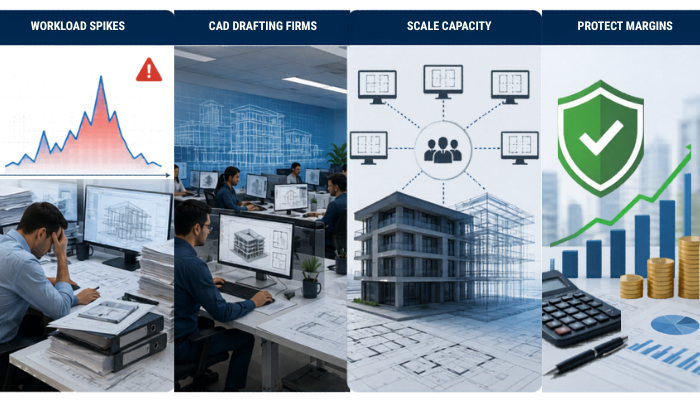
This common business bottleneck is why smart operators choose to team up with established CAD drafting firms. Working with an external drafting hub gives you instant access to a skilled technical workforce without adding long-term employee overhead to your books.
You can ramp your drawing production up or scale it back down based on what your current project pipeline looks like. This operational flexibility gives you the confidence to bid on larger, complex contracts knowing your technical execution will remain rock-solid under tight deadlines.
The Digital Future: Building Information Modeling and Beyond
As construction tech continues to move forward, the line between flat lines and intelligent building data is disappearing. Top-tier drafting teams do not just hand over static files anymore. They structure your project data so it fits perfectly into modern building information modeling (BIM) platforms.
This digital framework links your 2D details, elevations, and shop sheets to a central, live database. If an engineer modifies a structural wall layout in one view, that change updates across every single sheet automatically.
Adopting these connected workflows keeps your business competitive and efficient. Ultimately, it means fewer headaches during construction, clearer communication between trades, and a finished building that matches your original architectural vision perfectly.