

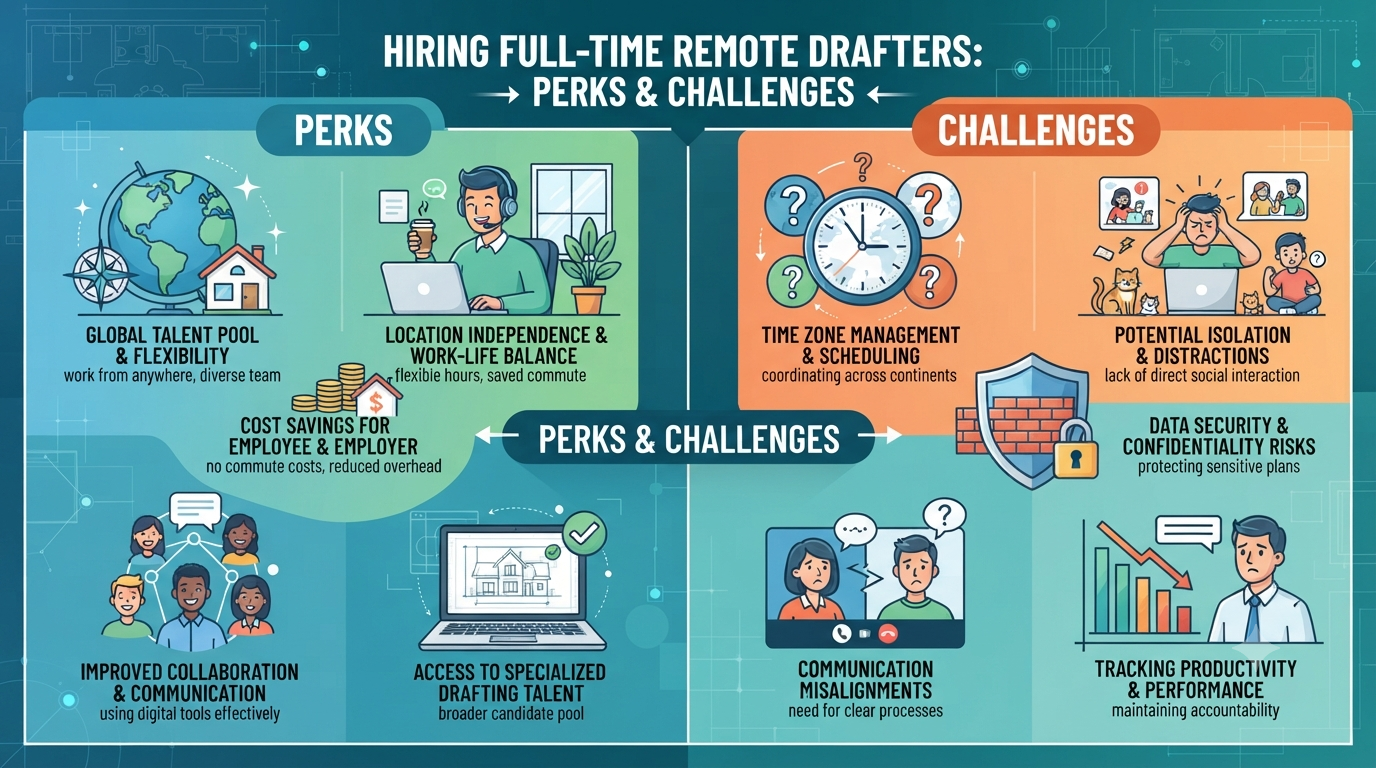
Drafting work never slows down. There’s always a permit set to draw or a shop drawing to return. And your team is probably already stretched thin. Hiring full-time remote drafters has become a popular choice for architects, contractors, and engineers. Unlike adding an in-house staff member, remote hiring is fairly simple. Full-time remote drafters also present some challenges; however, with the right approach, these are easy to handle. This article outlines the pros, cons, and costs associated with hiring remote drafting services.
Short Answer: Rising in-house drafting costs give remote drafting services a distinct advantage. Communicating and enforcing drawing standards across different time zones can be challenging. Data security can also be a concern. These challenges can largely be mitigated by implementing clear processes or outsourcing the work to a trusted drafting service.
Why Remote Drafters Often Beat In-House Hires
There are real limits to hiring in-house drafters. You are restricted to people who live near your office, and you are stuck paying for office space, even if you are not at full capacity. Especially in slow months, this can be a drain on your budget.
With remote hiring, you’re not constrained to local talent and can hire drafting services based on the exact skills you’re looking for, like millwork drafting or title drafting services. You’re also free to scale your drafting services up or down based on the ebb and flow of your work.
| Remote Drafter | In-House Drafter | |
| Talent pool | Wide, not limited by location | Limited to your area |
| Overhead | Low, no office or desk costs | Higher, includes space and equipment |
| Scaling | Easy to add or reduce capacity | Slower and more costly |
| Daily oversight | Needs clear systems | Easier in person |
In the case where in-person work is necessary, then in-house staff would be more appropriate. Otherwise, remote or hybrid work would be better for the staff and the company.
The Biggest Perks of Remote Drafters
- Lower costs: Funds previously spent on office space and equipment are saved.
- Faster turnaround: Drawings can be completed faster because a remote drafter has fewer office interruptions and a shorter commute.
- Specialized skills: Contracting remote staff gives more opportunity to hire staff with the exact skills needed for more specific aspects of drafting, such as shop drawings, millwork details, tile layouts, and BIM modeling.
- Better focus: Drafting work can be completed remotely, and drawings can be done more efficiently in quiet and distraction-free locations.
- Business continuity: Remote workers can continue to do their work despite office or weather closures.
- Flexible capacity: The company is not locked into having a certain number of staff members.
The Challenges (and Simple Fixes)
Knowing these challenges gives you a better chance of success with remote work.
Variation in standards: When different draftsmen use different dimension styles and text styles, drawings quickly become disorganized.
Fix: On the first day, provide a template, guidelines, and an example drawing.
Difference in Time zones: Collaborating across time zones makes scheduling calls and giving feedback on drawings challenging.
Fix: Agree on times during the day to interact.
Data security: There may be sensitive information in the project files.
Fix: Implement a secure file-sharing system and limit access to only those necessary to view the file.
Quality control: Remote working increases the risk of missing something when work is done.
Fix: Set clearly defined milestones and use a review checklist.
What to Check Before Outsourcing Drafting
It can take a few hours to set up a system to outsource drafting work, but it will save weeks of frustration. Start with:
Look beyond the resume: Having “AutoCAD” or “Revit” on a resume does not indicate the person’s drafting ability. Ask for examples of their work such as shop drawings or permit sets. Two people with five years of experience can have different skill levels.
Check industry experience: Millwork and tile drafting need close attention to dimensions, materials, joints, and site measurements. Ask for samples such as cabinet or casework shop drawings, or tile layout plans showing patterns, cuts, and borders.
Accuracy test, not just speed: Fast, incorrect drawings will cause more work for your engineers. Review a portfolio to evaluate detail, layer usage, annotations, and compliance with your standards.
Confirm they adhere to your standards: Ideally, find someone who is able to modify your templates as opposed to someone who uses personal templates and methods. Look for someone with good communication skills.
Judge communication: Evaluate if the drawings are clearly communicating the intent of the instructions. Report issues to the designer, as opposed to making assumptions.
Match working hours: Set similar working hours to minimize feedback cycles and revisions under tight deadlines.
Match your software: Standardize the software to be used. Use the same file formats and versions as you.
Look for Long-Term: Look for someone who is reliable and consistent, and who will adapt to your methods and procedures.
Agree on security: Agree on security and file storage before commencement of work. This will help in the long term, as the same drafter who is assisting you now may in the future be preparing and reviewing larger drawings.
How to Onboard a Remote Drafter in the First 30 Days
Within the first 30 days, onboard a remote drafter in the following manner because A strong start decides how smoothly the next months go.
- Week 1: Familiarize the drafter with templates, standards, and software. Show one completed drawing.
- Week 2: Assign more detailed tasks and review all work completed.
- Week 3: Increase the size of the tasks assigned.
- Week 4: Hold a short review. Discuss what went well, gaps in the process, and set goals for the next quarter.
Many challenges in onboarding come from management style rather than from employees. Offering clear instructions and giving timely feedback helps employees correct most mistakes.
Common Mistakes to Avoid When Hiring Remote Drafters
Even strong teams make these mistakes.
- Go with the lowest bid: The cheapest quote often contains the most rework and delays.
- No sample task: Interviews assess confidence but don’t assess work; this is why a test is important.
- Relying on vague standards: If a standard is shared or not clearly communicated, it is difficult for drafters to follow.
- Giving no markups: Unless they are clear and concise, repeated revisions will be necessary.
- Expecting a drafter to replace an engineer: A remote drafter cannot replace an engineer. Drafters cannot make engineering judgments. More capacity in design is also required to fill the gap.
- Staying silent on problems: Keeping quiet about small issues. Feedback is necessary to get small improvements.
Hire One Person or Add Capacity?
Think about where the biggest challenge is for your team before making this decision. Would an extra drafter really help? Would marking drawings take less time for engineers if they had more design capacity? A permanent hire builds your internal team. On the other hand, Extra capacity, such as a dedicated drafter or a drafting company, adds skills to the team and helps you in several situations, including:
- Increased volume of projects.
- Backlog of drawing revisions.
- Meeting tight deadlines.
- Variable workload.
- Difficulty in hiring local talent.
A drafting company, on the other hand, provides a complete team of MEP draftsmen, millwork and tile specialists, BIM modelers, and architectural draftsmen to complement your existing staff. With a drafting company, you will have the flexibility and capacity to meet your deadlines. They provide support to the entire team necessary to complete the drawings. If one team member is unavailable, someone else will do the task, and the drawing is reviewed before it is delivered to the client.
Cost and Efficiency: Look at the Full Picture
Hourly rates may seem attractive, but consider what it costs to get the drawing completed on time and accurately.
Consider the following when comparing hourly rates:
- Time spent by Management in training the employee to perform the work.
- Work volume and staff turnover.
- Loss of potential business due to inability to meet client demands.
- Additional overhead costs associated with staff hire, including IT infrastructure, payroll, and HR.
- Increasing rework, as a cheap drafter who makes many errors costs more later.
Compare total costs associated with hiring additional capacity versus outsourcing the work to a drafting company. Make sure the costs cover the services and resources the company will provide, including recruitment, hardware, software, and potential replacement of the drafter.
Project-Based vs. Retainer Models
Drafting companies allow you to choose between a retainer model or a project-based model.
Project-Based: The drafter will get paid per shop drawing or permit set. Suitable for infrequent, one-time jobs where costs and schedules are known in advance.
Retainer: A monthly fee is provided to the drafter with a dedicated drafting team for the duration. The longer the team works with you, the more efficiently they can produce the drawings. It feels like having an employee on staff, but without the hassle of recruiting and managing that employee.
Mostly one-off jobs? Go project-based. Steady work? A retainer usually saves time. Unsure? Start with one project, then move to a retainer once you trust the team.
How to Choose the Right Drafting Company
Don’t take chances with an unproven drafting company. Here is a list of questions to ask:
- Do they have experience with the type of project you need them to work on?
- What programs do they use, and are they proficient with BIM?
- Is there a quality assurance process that is followed prior to delivering drawings to you?
- When you contact them, are you put in touch with a knowledgeable person who promptly addresses your concerns?
- Are your files protected and secured?
When selecting a drafter or a drafting company, pay attention to the future. Your needs may grow into new project types, and a good partner should be able to grow with you. Pay attention to the questions they ask early on. A good partner asks about your project, not just your budget.
How McLine Studios Stands Out
Drafting services have become widely available, and many companies make similar claims. McLine Studios aims to be a dependable one-stop partner for architects, contractors, engineers, and developers in the global market.
McLine Studios offers numerous services under one roof:
- Shop drawing services to coordinate fabrication and installation.
- Millwork drafting services for cabinets, casework, paneling, and custom joinery.
- Tile drafting services for floor, and wall layouts.
- CAD drafting services for accurate drawings based on different standards.
- Revit drafting services and modeling for BIM coordination.
- Permit set drawings prepared for approval submissions.
- Construction documentations for teams.
Partnering with McLine Studios gives you the advantage of saving time and money, as you don’t have to manage multiple vendors and repeat your standards to each of them. Having one team draw all the project documents helps eliminate coordination errors. You have the option of using McLine’s services project by project, or retaining them to work on your projects exclusively.
Final Thoughts
Depending on your workload and location, hiring full-time remote drafters can reduce costs and increase efficiency. Establish systems to coordinate work and govern quality, and ensure they are implemented consistently. Managing remote workers can seem overwhelming, but an experienced drafting company can provide the same benefits with less hassle.
Ready to get started? Visit McLine Studios to discuss your drafting needs and choose the right engagement model.
Frequently Asked Questions
Remote drafters are cost-effective, have more varied skills, and are easier to scale than in-house drafters. Teams that require very close interaction typically benefit from an in-house drafter. Most firms use a combination of the two.
What are the main challenges of hiring remote drafters?
Communication, standardization, time zones, security, and quality control are all common challenges. Most of these issues can be mitigated through processes and procedures.
Ask to see their portfolio, and if you are impressed with what you see, give them a small sample task to test their ability to work to your standards and how they incorporate feedback.
A single drafter would be appropriate for smaller, steady workloads. A company would be better if you require varying or more complex skills.
Project-based drafting means you agree to a one-time scope and price. A retainer allows you to have a drafter or team available to you every month.
Agree on processes for how files will be stored and deleted, limit file access to only those necessary, and have drafters sign confidentiality agreements. Use secure file shares to transfer data.
You can outsource shop drawings, millwork drafting, tile drafting, CAD drafting, Revit modeling, and permit sets.